Mountain Singers Knew a Stage Fright Cure That Therapists Are Only Now Understanding
When Mountain Folk Gathered to Sing
Every few months in 19th-century Appalachian communities, something remarkable happened. Families would travel for miles to gather in wooden churches or community halls for "Sacred Harp" singing conventions. These weren't performances with audiences — they were participatory events where everyone sang together using a unique musical tradition.
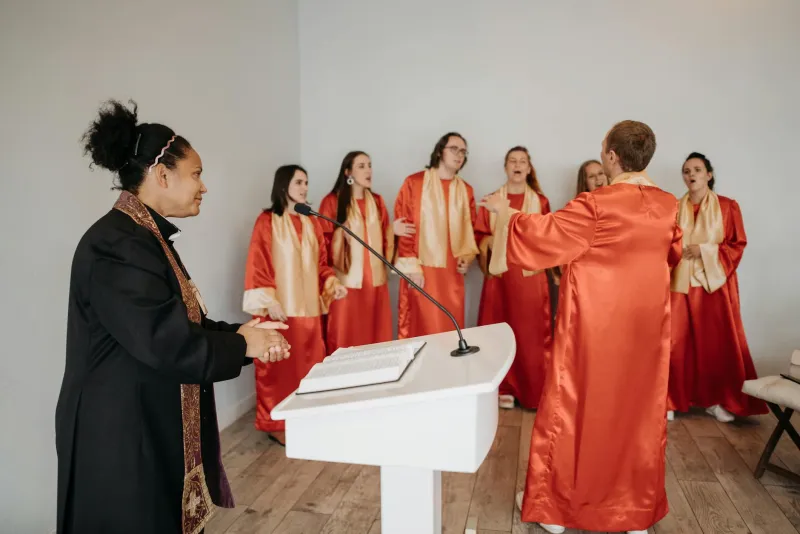
 Photo: Sacred Harp, via s1.cdn.autoevolution.com
What modern researchers have discovered is that these gatherings included a group warm-up ritual that accidentally became one of the most effective anxiety treatments ever developed.
The Humming That Healed
Before launching into complex four-part harmonies, Sacred Harp singers always began with the same ritual: communal humming. The entire group would hum together for several minutes, creating a resonant buzz that filled the room and vibrated through their bodies.
This wasn't just vocal preparation. Recent neuroscience research has revealed that sustained humming activates the vagus nerve — the longest cranial nerve that connects the brain to major organs and regulates the body's stress response.
Dr. Elena Rodriguez, who studies vagal tone at Vanderbilt University, explains: "What these singers were doing accidentally was triggering the parasympathetic nervous system. The vibrations from group humming create a measurable physiological calm response."
The Science Behind the Vibration
When you hum, the vibrations stimulate the vagus nerve through several mechanisms. The physical vibration in the chest and throat area directly activates vagal pathways. The controlled breathing required for sustained humming further stimulates this nerve network.
But group humming adds another dimension: entrainment. When people hum together, their breathing patterns, heart rates, and brainwave activity begin to synchronize. This creates a collective calm that's more powerful than individual relaxation techniques.
Modern anxiety treatment increasingly focuses on vagal tone — the strength and responsiveness of this crucial nerve. People with higher vagal tone recover more quickly from stress, have better emotional regulation, and show greater resilience to anxiety.
The Shape-Note Secret
Sacred Harp singing used a unique notation system called "shape notes" where different note values were represented by different geometric shapes. Singers would first "sing the shapes" — literally singing "fa, sol, la, mi" instead of words.
This practice required intense focus and coordination, creating what psychologists now recognize as a flow state. The combination of focused attention, controlled breathing, and group synchronization produced a powerful anxiety-reducing effect that lasted for hours after singing ended.
Many singers reported feeling unusually calm and confident during and after these gatherings, even when facing difficult life circumstances.
The Breathing Pattern Discovery
Analysis of Sacred Harp singing reveals specific breathing patterns that modern breath-work therapists are now studying. The music required singers to take deep breaths at regular intervals, hold notes for extended periods, and exhale slowly and completely.
This created a natural breathing rhythm that optimizes oxygen and carbon dioxide levels in ways that reduce anxiety. The pattern closely matches "coherent breathing" techniques that are now prescribed for panic disorders and PTSD.
Unlike modern breathing exercises practiced in isolation, Sacred Harp singing embedded these patterns in social activity, making them more sustainable and enjoyable.
The Community Cure
Perhaps most importantly, Sacred Harp singing addressed anxiety through community connection. Singers sat in a square formation facing each other, creating intimate eye contact and shared vulnerability.
The music itself dealt with themes of struggle, loss, and hope — allowing participants to process difficult emotions in a supportive group setting. This combination of physiological regulation and emotional processing created comprehensive anxiety relief.
Modern research on social anxiety consistently shows that group activities involving synchronized movement, breathing, or vocalization are among the most effective treatments available.
Rediscovering the Techniques
Some therapists are now incorporating elements of Sacred Harp singing into anxiety treatment:
- Group humming sessions that activate the vagus nerve
- Breathing exercises based on traditional singing patterns
- Community singing activities that build social connection
- Focus techniques derived from shape-note sight-reading
These approaches often work faster and more sustainably than individual therapy alone, particularly for social anxiety and performance fears.
The Modern Application
You don't need to join a Sacred Harp group to benefit from these discoveries. Simple humming exercises can activate the vagus nerve and reduce anxiety within minutes:
- Hum for 60 seconds while focusing on the vibration in your chest
- Practice with others when possible for enhanced entrainment effects
- Use humming as a pre-performance ritual to calm stage fright
- Incorporate humming into meditation or mindfulness practices
What We Lost and Found
The decline of community singing traditions in the 20th century may have contributed to rising anxiety rates. Sacred Harp singing provided regular, accessible anxiety relief that required no special training or equipment.
Modern anxiety treatment is rediscovering what Appalachian communities knew intuitively: the most powerful healing happens when physiological regulation, emotional expression, and social connection combine.
The Vibration Revolution
As anxiety disorders reach epidemic levels in America, researchers are looking beyond pharmaceutical solutions to traditional practices that worked for centuries. Sacred Harp singing offers a blueprint for anxiety treatment that's both scientifically validated and deeply human.
The mountain singers who gathered in wooden churches never knew they were conducting sophisticated nervous system therapy. They were simply creating beauty together — and accidentally discovering one of the most effective anxiety treatments ever developed.
Sometimes the most advanced medicine is also the most ancient, waiting in plain sight for science to catch up.