Barn Dances Were the Original CrossFit — And the Science Behind Why They Worked Is Genuinely Surprising
What Was Actually Happening in That Barn
Picture a barn dance in rural Ohio or Tennessee sometime around 1890. The fiddle player has been going for two hours. Couples are swinging through a Virginia reel, hands locked, feet landing in sync with forty other people on a plank floor that bounces faintly with the collective rhythm. Nobody's wearing a heart rate monitor. Nobody's tracking macros. But by the time the night ends, they've covered the equivalent of several miles on foot, maintained aerobic output for sustained intervals, and done something to their nervous systems that modern fitness science is just starting to articulate.
Barn dances weren't exercise. They were community events, courtship rituals, seasonal celebrations. But they were also, accidentally, one of the most neurologically sophisticated physical activities that ordinary Americans ever practiced — and the specific features that made them work have almost entirely vanished from how we think about fitness today.
The Tempo Was Not a Coincidence
Traditional American barn dance music — reels, jigs, square dance calls — typically runs between 120 and 132 beats per minute. That range is not arbitrary, even if the musicians who settled on it had no idea why it felt right.
Research in exercise science and music psychology has consistently found that 120 to 130 BPM is the sweet spot for sustained aerobic output in untrained individuals. It's fast enough to elevate heart rate into a cardiorespiratory training zone but not so fast that it triggers the kind of anaerobic stress that causes early fatigue. It's also, notably, close to the natural resonant frequency of human walking cadence, which means the body locks onto it with less conscious effort than other tempos require.
Modern fitness playlists are engineered to these exact specifications. Peloton instructors and running app designers spend real money getting tempo right. The fiddle players at 19th-century barn dances figured it out by feel, across generations of playing to crowds who would simply stop dancing if the pace was wrong.
The Partner Effect
Here's where it gets neurologically interesting. Barn dancing wasn't solo movement — it was synchronized movement with a partner and, in square dance formations, with a group of eight or more people simultaneously.
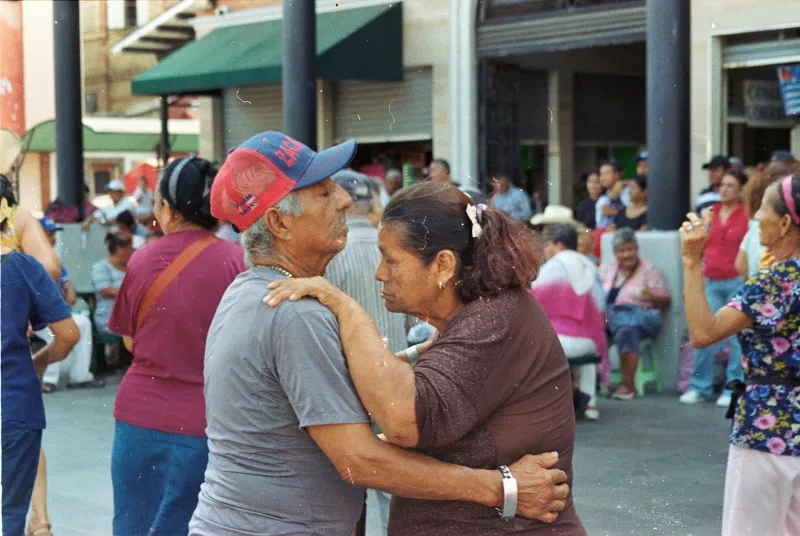
Synchronized movement between people triggers a neurological phenomenon that researchers call interpersonal motor coupling. When two people move in coordinated rhythm together — particularly with physical contact, as in partner dancing — their nervous systems begin to entrain. Heart rate variability patterns converge. Breathing rhythms align. And crucially, the brain releases a significantly larger pulse of endorphins than solo movement at equivalent intensity produces.
This is not a small effect. A study out of Oxford found that synchronized group movement lowered pain thresholds — a proxy for endorphin activity — substantially more than the same movement performed individually. The social element wasn't decoration. It was load-bearing.
This is also, not coincidentally, exactly what CrossFit gyms discovered when they built their model around group classes rather than individual programming. The community synchronization piece drives adherence and intensity in ways that solo gym work rarely matches. CrossFit's founders stumbled onto this through observation. Barn dancers had been running the experiment for two hundred years.
The Caller Was Doing Cognitive Load Management
One feature of traditional square dancing that tends to get dismissed as quaint is the caller — the person who shouts out the next move while the current one is still being executed. Do-si-do. Promenade. Swing your partner. Allemande left.
What the caller was doing, functionally, was managing cognitive load in real time. Participants had to hold the current movement in motor memory while processing the next instruction — a dual-task demand that engages the prefrontal cortex in ways that pure physical exercise doesn't. This is the same principle behind exergames and the growing field of cognitive fitness training, where physical exercise is paired with simultaneous mental tasks to produce greater neuroplasticity benefits than either activity alone.
Studies on dual-task exercise — walking while doing math problems, cycling while tracking visual cues — consistently show stronger benefits for executive function and long-term cognitive health than single-task physical activity. The barn dance caller was running a dual-task protocol every Friday night, keeping fifty farmers cognitively sharp through the winter months without anyone framing it that way.
The Social Stakes Were the Secret Ingredient
There's one more element that modern fitness culture has largely failed to replicate: consequence.
At a barn dance, you were dancing in front of your neighbors, your potential in-laws, your community. Dropping the rhythm, losing the step, failing to catch your partner's hand — these weren't private failures. They were public ones, witnessed by people you'd see at church on Sunday. That social pressure created what psychologists call motivational salience — the brain's tendency to perform more consistently and with greater effort when the stakes feel real.
This is partly why team sports produce better fitness outcomes than solo gym work for most people, and why group fitness classes have higher completion rates than individual programs. The barn dance had this feature baked into its social architecture in ways that no subscription fitness app has ever fully managed.
What Got Lost
Barn dances faded as rural communities urbanized, as recorded music replaced live performance, and as organized recreation shifted from community-generated events to commercial entertainment. By the mid-20th century, the practice had retreated to folk revival circles and square dance clubs — charming, but no longer the central social institution it had been.
With it went a form of physical and cognitive exercise that hit an unusual number of beneficial targets simultaneously: sustained aerobic work at optimal tempo, partner-synchronized movement with its endorphin amplification, dual-task cognitive engagement from caller-driven sequencing, and social accountability as a performance motivator.
Modern fitness culture has been reassembling these pieces separately — group classes here, rhythm-based workouts there, social accountability apps somewhere else — without ever quite recognizing that American farmers had the whole package figured out in a wooden building full of hay.
You can find square dance clubs in most mid-sized American cities if you look. They tend to be populated by older adults who've been doing it for decades and are, almost universally, in suspiciously good shape for their age. That's probably not a coincidence either.