These 1920s Bird Watchers Stumbled Onto a Brain Reset That Beats Every Attention Hack You've Ever Tried
The Walk Nobody Wrote a Book About
Somewhere around 1923, a field biologist named Aretas Saunders was tramping through the forests of western Montana with a notebook and no particular agenda. He wasn't looking for anything. He was listening — cataloging bird calls with such obsessive focus that he'd stand motionless for twenty minutes, eyes half-closed, decoding the layered acoustics of a single meadow. He called it simply "going out to hear."
Saunders wasn't alone. Across the early 20th century, a loose network of field naturalists, nature writers, and amateur ornithologists developed what amounted to a shared practice: walks taken specifically, almost exclusively, for auditory attention. Not hiking. Not birdwatching in the traditional sense. Sound walks. And while nobody gave the technique a catchy name or sold it in a weekend retreat, they were building something that neuroscience is only now starting to fully appreciate.
What Made These Walks Different
Here's the thing that separates a listening walk from a regular stroll in the park: the deliberate suppression of visual priority.
Humans are overwhelmingly visual creatures. Something like 70 percent of our sensory cortex is devoted to processing what we see. When you walk outside normally, your brain is running a constant visual sweep — threat detection, spatial navigation, social scanning, screen-checking if you've got a phone in hand. It's exhausting in a way you don't consciously register until you stop.
The early naturalists, almost by accident, discovered that forcing your attention onto sound alone interrupts that visual dominance loop. Saunders and his contemporaries described the experience in their field journals in almost meditative terms — a quieting of mental "chatter," an unusual sharpness of focus afterward. John Burroughs, one of the most widely read nature writers of the era, wrote extensively about the restorative quality of what he called "ear-first" walks along the Hudson Valley. He noticed he returned from them thinking more clearly, less irritable, more capable of sustained concentration.
They had no framework for why. They just knew it worked.
What the Brain Is Actually Doing
Fast-forward to research coming out of labs at places like UC Berkeley and the University of Oregon, and the mechanism is becoming clearer. When you deliberately shift attention to auditory input — particularly complex, layered natural soundscapes like birdsong, wind through leaves, or running water — you activate what researchers call the default mode network in a very specific way.
The default mode network is the brain's background operating system. It's active when you're not focused on a task, and in modern overstimulated life, it tends to run hot — looping anxious thoughts, replaying social interactions, generating that low-grade mental noise that makes it hard to concentrate on anything for longer than four minutes (which, by the way, is about the current average for sustained digital attention).
Natural soundscapes, it turns out, engage the auditory cortex just enough to give the visual and prefrontal systems a genuine rest — without the complete sensory withdrawal of sitting still in a dark room. It's sometimes called soft fascination by attention restoration researchers, and it's distinct from both active focus and passive zoning out. Your brain is gently occupied, not taxed.
What the 1920s naturalists were doing, without knowing it, was cycling their attentional systems through a kind of active recovery — the neurological equivalent of an easy run after a hard training day.
Why This Beats What You're Already Paying For
Here's where it gets a little uncomfortable for the $40-billion wellness industry.
Meditation is genuinely useful. But the research on it consistently shows that it requires weeks or months of practice before most people see meaningful benefits — and the dropout rate for meditation apps hovers somewhere between 50 and 70 percent within the first month. The effort of not thinking is, paradoxically, effortful. Many people with anxiety or ADHD find traditional seated meditation actively counterproductive, at least initially.
Listening walks sidestep all of that. There's no technique to master. You don't have to clear your mind — you just redirect it. You don't sit still. You move, which itself has documented benefits for mood regulation and cognitive function. And unlike a screen-based wellness tool, the practice requires nothing except going outside and choosing to pay attention to what you hear rather than what you see.
Studies on attention restoration therapy — a framework developed by environmental psychologists Rachel and Stephen Kaplan — found that even 20 minutes in a natural sound environment measurably improved directed-attention capacity. That's the kind of focus you need for complex work, difficult conversations, or just getting through a Tuesday without feeling like your brain is running on fumes.
How to Actually Do It
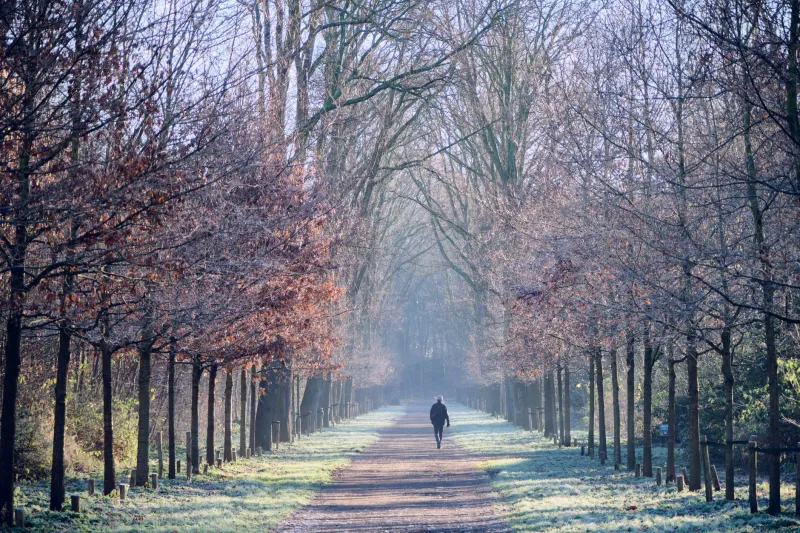
The original naturalists kept it simple, and you should too. Pick a route — a park, a trail, even a quiet residential block with some trees. Leave the earbuds out. Start walking at a pace slower than you think you need to.
For the first five minutes, just notice the loudest sounds. Traffic, wind, whatever's dominant. Then, gradually, start listening past them. What's underneath? A bird three blocks over. The specific pitch of wind through a chain-link fence versus through leaves. Water moving somewhere you can't see.
The goal isn't silence. It's depth of listening. Saunders used to say he was trying to hear the forest's "full score" rather than just the melody on top. That's the mental shift that matters.
Do it for 20 to 30 minutes. Don't bring a podcast. Don't check your phone. When you get back, notice whether your thinking feels different — cleaner, maybe, or less cluttered.
Chances are, it will. A century of field naturalists figured that out before anyone had the science to explain it. You just needed someone to finally tell you it was a thing.