Before Therapists Had a Word for It, Appalachian Grandmothers Were Already Doing It
The Panic Spiral Nobody Had a Diagnosis For
Somewhere in eastern Kentucky, maybe 1940, a teenage girl is hyperventilating in a farmhouse kitchen. Her grandmother doesn't call a doctor. She doesn't recite scripture or tell the girl to calm down. Instead, she hands her a basket of dried beans and tells her to sort them — one by one, into two piles — while pressing her bare feet flat against the cold wood floor.
Within minutes, the girl's breathing slows.
That grandmother didn't have a clinical framework. She didn't know about the amygdala, sensory processing, or proprioceptive input. What she had was something passed down through generations of women who'd watched other women fall apart under the weight of hard mountain life — and figured out, through pure observation, exactly what brought them back.
Decades later, therapists would coin a term for what she was doing: grounding. But the technique itself? That was already old news in the hills.
What the Mountain Folk Actually Did
Appalachian grounding rituals — nobody called them that, of course — showed up in several overlapping forms across communities in West Virginia, Tennessee, Virginia, and the Carolinas. Folklorists who collected oral histories in the mid-20th century documented them without fully understanding what they were capturing.
The practices clustered around a few consistent elements:
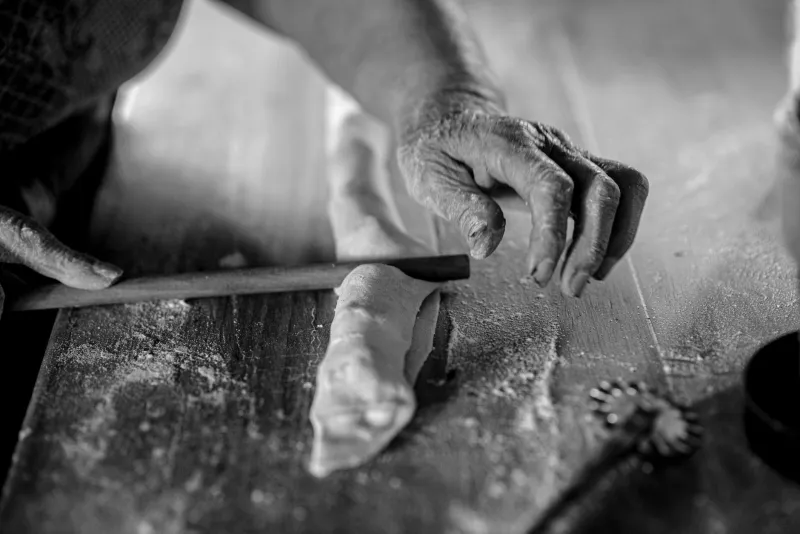
Texture contact. Grandmothers routinely instructed anxious family members to press their hands into cool garden soil, knead bread dough, or grip a rough-hewn wooden surface. The instruction was almost always tactile and immediate — touch something real.
Rhythmic repetitive tasks. Shelling peas. Churning butter. Braiding rope. Carding wool. These weren't just chores assigned to keep idle hands busy. Older women in these communities specifically steered panicking or grieving relatives toward tasks with a steady, repetitive physical rhythm. The motion mattered as much as the outcome.
Temperature anchoring. Cold water on the wrists. Bare feet on stone or cool earth. Several accounts describe grandmothers leading distressed family members outside to stand in a garden, shoes off, regardless of the season — as long as it wasn't dangerous.
Breath-paced counting. Not meditation in any formal sense, but a quiet instruction to count stitches, count steps, count beans — something that forced the mind to track a simple sequence rather than spiral.
None of this was written down in any official capacity. It lived in the hands and voices of women who learned it from the women before them.
Why It Nearly Vanished
The postwar suburban migration changed everything. When Appalachian families moved north and west for factory jobs in the 1940s and 50s, they left behind the physical landscape that made these practices possible. No garden soil. No wool to card. Linoleum floors instead of cold stone. Processed food that came pre-shelled, pre-sorted, pre-done.
The rituals didn't translate to a Cincinnati apartment. And the grandmothers who carried the knowledge aged out of the family conversation as mainstream American culture increasingly deferred to professional medicine for anything resembling mental distress.
By the 1970s, what had been intuitive community knowledge was largely gone — replaced, ironically, by therapeutic frameworks that were independently arriving at almost identical conclusions.
What Neuroscience Found When It Caught Up
Modern grounding therapy — developed formally in the 1990s as part of trauma treatment — works by redirecting the nervous system's attention away from an internal panic loop and toward immediate, concrete sensory input. The theory is that activating the senses interrupts the amygdala's threat-response cycle and re-engages the prefrontal cortex.
Sensory-processing researchers studying proprioception (the body's sense of its own position and pressure) have found that tactile input — especially from the hands and feet — sends particularly strong regulatory signals to the nervous system. Cold temperature contact with the wrists or feet activates the vagus nerve, which plays a direct role in calming the fight-or-flight response.
Rhythmic repetitive movement, separately, has been shown to reduce cortisol levels and promote a mild meditative state — something that researchers in music therapy and trauma treatment have been investigating for years.
In other words: every element of what those Appalachian grandmothers prescribed maps almost perfectly onto what clinical science now recommends for acute anxiety episodes. The soil. The cold floor. The rhythmic task. The counting.
They weren't guessing. They were observing across generations what actually worked — and encoding it into the fabric of daily domestic life so it would always be nearby when someone needed it.
The Part That Should Humble Us
Here's what's quietly remarkable about this story: formal grounding therapy took decades of clinical research, peer-reviewed trials, and professional infrastructure to arrive at a set of recommendations that a Kentucky grandmother could have told you in 1935 while handing you a basket of beans.
That's not an argument against science. It's an argument for paying closer attention to what folk communities figured out through necessity — especially when the communities doing the figuring were women, and rural, and poor, and therefore easy to dismiss.
Sensory researchers now studying historical oral records from Appalachian communities aren't finding primitive superstition. They're finding neurologically precise behavioral interventions that somehow survived without any of the institutional support that modern medicine takes for granted.
The next time you see a therapist recommend the 5-4-3-2-1 grounding technique — name five things you can see, four you can touch — remember that somewhere in the mountains, someone already knew. She just called it sorting beans.
Try It Yourself
You don't need a therapist's office or a wellness app. The next time anxiety starts pulling you under, try this:
Press your bare feet flat on the floor. Pick up something with texture — a rough stone, a handful of dry rice, a knotted rope. Count something simple and repetitive. If you can get your hands into soil or cold water, even better.
It's old knowledge. It works. And it's been hiding in plain sight the whole time.