Starving Through the Dust Bowl, These Families Accidentally Ate the Most Anti-Inflammatory Diet Ever Recorded
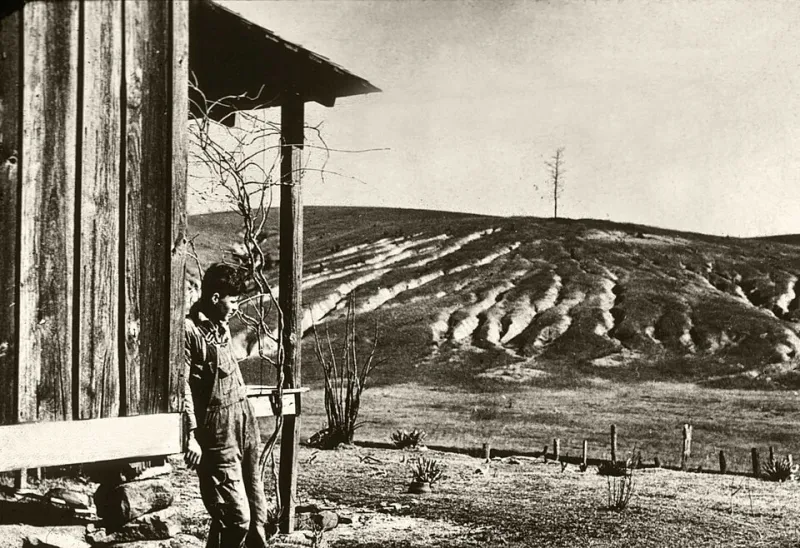
Photo: U.S. Department of Agriculture, Public domain, via Wikimedia Commons
When There Was Nothing Left to Eat
By 1935, families across Oklahoma, Kansas, and the Texas Panhandle were eating whatever they could hold onto. The topsoil was gone. The crops were gone. In many cases, the livestock was gone too. What remained were root cellars, wild plants growing along creek beds, organ meats that nobody wanted to waste, and jars of fermented food that had been put up the previous fall.
These weren't food choices. They were survival calculations made by exhausted people with very few options.
But here's the twist that nobody saw coming: what those families ate out of sheer desperation maps almost perfectly onto what modern inflammation researchers now consider one of the most protective dietary patterns a human body can follow. Not approximately. Precisely.
Scarcity, it turns out, accidentally engineered a nutritional blueprint that the wellness industry now charges hundreds of dollars to replicate.
What Was Actually on the Table
To understand why this matters, you have to look at the specific foods that Dust Bowl families relied on — and what those foods were doing biologically.
Fermented staples. Without reliable refrigeration and with limited access to fresh food, many Great Plains families depended heavily on fermented and preserved foods: sauerkraut, fermented corn mush, pickled vegetables from the root cellar, and sourdough starter that some families had maintained for decades. These foods are packed with live bacterial cultures — exactly what modern probiotic research identifies as foundational to gut health and systemic inflammation control.
Wild foraged greens. Dandelion, lamb's quarters, purslane, and various wild mustard greens were common additions to Depression-era meals across the Plains. These plants are extraordinarily dense in omega-3 fatty acids, polyphenols, and anti-inflammatory compounds. Purslane alone contains more omega-3s per serving than most fish. People were eating it because it was free and it grew near water. They had no idea it was a nutritional powerhouse.
Organ meats. When a family did slaughter an animal, nothing was wasted. Liver, kidney, heart, and tongue were regular meal components — not delicacies, just food. Organ meats are some of the most nutrient-dense foods in existence. Liver alone contains extraordinarily high concentrations of vitamin A, B12, iron, and CoQ10, all of which play direct roles in immune regulation and inflammation response.
Low sugar, low processed carbohydrates. This one happened entirely by accident. There was no money for candy, soda, white flour in abundance, or processed food products. The diet was naturally very low in refined sugar — which modern research consistently identifies as one of the primary dietary drivers of chronic inflammation.
Taken together, this is almost a textbook anti-inflammatory diet. The kind that functional medicine practitioners now build elaborate protocols around.
Why the Diet Disappeared So Completely
The postwar economic boom didn't just bring prosperity to the Plains — it brought Crisco, Wonder Bread, canned soup, and the full machinery of American processed food marketing. Families who had spent years eating wild greens and fermented mush were suddenly able to buy real food, the kind that came in boxes and cans and represented everything that poverty had denied them.
The foods of the Dust Bowl became associated with shame and hardship. Nobody wanted to eat dandelion greens when they could afford pot roast. Nobody wanted sourdough starter when sliced white bread was right there on the grocery shelf. The fermented jars disappeared from root cellars. The foraging knowledge faded within a generation.
By the 1960s, the dietary pattern that had — accidentally — kept inflammatory markers low in some of the most stressed bodies in American history had been almost completely abandoned in favor of a food landscape that was doing the exact opposite.
What Nutrition Researchers Found in the Records
A handful of nutrition historians and public health researchers have spent years combing through Depression-era meal records, USDA agricultural surveys, and oral history archives from the 1930s and 40s. What they found surprised them.
Chronic inflammatory diseases — the ones now epidemic in the US, including type 2 diabetes, cardiovascular disease, and certain autoimmune conditions — were relatively uncommon in these communities during and immediately following the Depression years, despite the enormous physical and psychological stress these populations were under. Researchers are careful not to over-attribute causation, but the dietary pattern keeps coming up as a variable worth examining.
The fermented foods, the wild plants, the organ meats, the near-total absence of refined sugar — it wasn't a wellness protocol. It was poverty. But the body didn't know the difference.
The Quiet Irony of Modern Wellness
Walk into any upscale grocery store today and you'll find grass-fed liver pâté, dandelion green salads, artisanal sourdough made with century-old starter, and purslane listed as a specialty green. You'll pay a premium for all of it. Wellness influencers will explain the science behind each item in careful, authoritative detail.
Dust Bowl families ate all of it. Every week. Because it was what they had.
The knowledge those communities carried — about foraging, fermentation, using the whole animal, relying on what grows locally — was treated as something to escape rather than preserve. It took decades of nutrition research to circle back around to what desperation had already figured out.
What You Can Actually Take From This
You don't need to recreate the hardship. But the dietary principles are accessible and genuinely useful:
Add a fermented food to one meal a day — real sauerkraut, kimchi, or plain yogurt with live cultures. Dandelion greens are available at most health food stores and many farmers markets. Chicken liver is one of the cheapest cuts at any butcher and one of the most nutrient-dense foods you can buy. And cutting refined sugar — even partially — has well-documented anti-inflammatory effects.
The Dust Bowl families didn't choose any of this. But they stumbled onto something that decades of nutritional science is still trying to fully map. That's worth knowing.