Clockmakers in 1800s Switzerland Kept Outliving Everyone Around Them — Scientists Think They Know the Surprising Reason
Something Was Off in the Death Records
In the canton of Neuchâtel, Switzerland — the historical heart of European precision watchmaking — local historians noticed something odd when they started systematically reviewing 19th-century parish mortality records in the 1970s. The craftsmen who spent their working lives building clock and watch mechanisms were, on average, outliving virtually every other occupational group in their communities.
Not by a little. By a margin significant enough to be statistically uncomfortable to ignore.
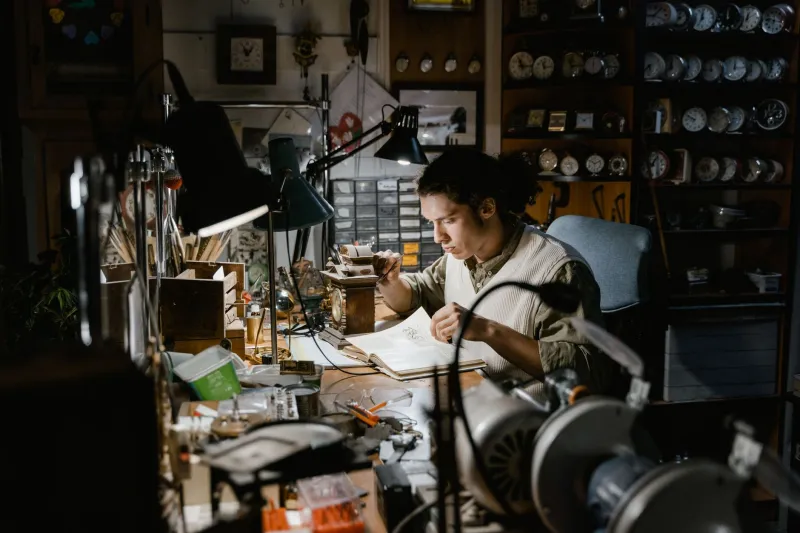
They weren't wealthier than merchants. They weren't better fed than farmers who had direct access to food. They weren't protected from disease the way physicians might theoretically be. They were just men who sat at benches, in good light, working with tiny tools and extraordinary patience, day after day, for decades.
And somehow, that kept killing them later than almost anything else.
The Horological Anomaly
Similar patterns showed up when researchers looked at English clockmaking centers — particularly in Clerkenwell, London, which was the hub of the British watch trade throughout the 1800s. Precision craftspeople in these districts showed lower rates of cardiovascular disease, fewer recorded incidents of what historical records described as "nervous ailments" (a catch-all that likely included anxiety disorders, hypertension-related conditions, and stress-driven illness), and longer productive working lives than comparable tradespeople.
The anomaly resisted easy explanation for a long time. Early theories focused on socioeconomic factors, but those didn't fully hold up — clockmakers in many regions were skilled tradespeople of middling income, not wealthy elites. Indoor work meant less exposure to harsh weather, which accounted for something, but not enough to explain the cardiovascular gap.
It wasn't until neuroscience started seriously investigating the physiological effects of sustained fine-motor precision work that a more compelling theory began to emerge.
What Tiny Gears Might Do to Your Nervous System
Here's the part that's genuinely surprising. Contemporary neuroscientists studying flow states and focused manual work have identified something they're calling precision-induced parasympathetic entrainment — a somewhat unwieldy term for a fascinating phenomenon.
When the human brain engages in sustained fine-motor tasks requiring extreme precision — the kind where a single tremor of the hand ruins hours of work — it enters a neurological state that shares significant overlap with deep meditative states, but through a completely different door. The task demands total attentional focus, which suppresses the default mode network (the part of the brain associated with rumination, self-referential worry, and stress cycling). At the same time, the slow, deliberate, controlled hand movements appear to regulate breathing rhythm passively — craftspeople doing precision work naturally slow and deepen their respiration without being aware of it.
The result is a sustained low-arousal, high-focus state that, if maintained for hours daily over years, may produce lasting changes in autonomic nervous system baseline. In simpler terms: the clockmakers may have been accidentally meditating for eight hours a day, every day, for their entire careers.
The Descendants Study That Raised More Questions
In a small but provocative research thread that hasn't received wide coverage outside specialist journals, scientists in Switzerland began looking at the genetic profiles of families with multi-generational clockmaking histories in the Jura region. What they found was preliminary but intriguing: certain genetic markers associated with lower baseline inflammatory response and more regulated HPA axis function (the hormonal stress-response pathway) appeared at slightly elevated rates in these lineages compared to regional controls.
The researchers were careful not to overclaim. Genetics is complicated, the sample sizes were modest, and correlation is obviously not causation. But the hypothesis they're working with is interesting: if sustained precision work over a lifetime genuinely modulates the stress-response system in measurable ways, and if epigenetic mechanisms allow some of those regulatory patterns to influence gene expression across generations, then centuries of clockmaking culture in specific Swiss valleys might have left a faint but detectable biological signature in the people who descended from it.
It's speculative. It's also the kind of idea that's hard to stop thinking about.
The Daily Rhythm Nobody Talks About
Beyond the neuroscience of the work itself, historians of the Swiss watchmaking trade have noted something else about how these craftspeople structured their days that looks increasingly significant in retrospect.
Precision assembly work can't be rushed. It can't be done while distracted, multitasked, or squeezed into fragmented attention windows. The nature of the craft imposed a working rhythm that was — by modern standards — almost absurdly deliberate. Long uninterrupted focus periods. Natural breaks dictated by the work itself rather than by external scheduling pressure. A pace that was slow not because the workers were lazy, but because the work demanded it.
What they had, without knowing it, was something modern productivity researchers have been trying to engineer back into knowledge work for two decades: deep, uninterrupted, single-task focus as the default mode of the workday rather than the exception.
The health implications of that kind of sustained attentional environment, maintained over a full career, are only now being taken seriously.
What This Means If You Sit at a Desk All Day
Most Americans spend their working hours in the exact opposite cognitive environment from a 19th-century clockmaker's bench — fragmented attention, constant notification interruptions, task-switching as the norm rather than the exception. The research emerging from horological history doesn't suggest you need to start building pocket watches. But it does raise a pointed question about what we've traded away by normalizing constant partial attention as a work style.
The clockmakers didn't have a wellness strategy. They had a craft that forced them into one, every single day, whether they thought about it that way or not. The gears kept time. And apparently, so did something in their bodies.