Cold War Submarine Crews Breathed Their Way Through Panic — And Sleep Labs Just Proved It Works Better Than Anything We've Got
The Breathing Secret Buried in a Classified Manual
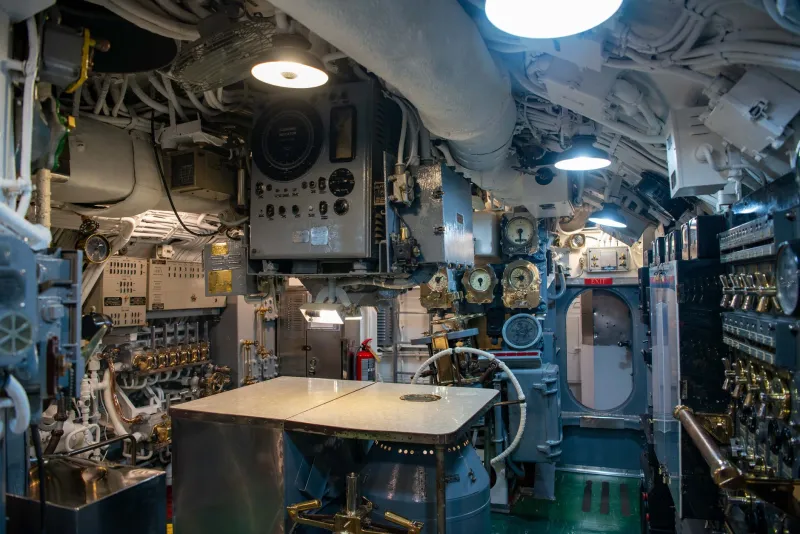
Somewhere in a declassified Navy archive, tucked between maintenance schedules and sonar protocols, there's a breathing exercise that nobody outside the submarine service ever thought much about. It wasn't glamorous. It didn't have a brand name. It was just something Cold War-era submariners did when the air got thin, the walls felt close, and the stress of operating 400 feet underwater started pressing in from every direction.
For decades, it stayed there — useful, forgotten, and almost completely invisible to mainstream medicine.
Then sleep researchers at a university lab in the Pacific Northwest started looking at archival physiological data from submarine crews, and something unexpected jumped out of the numbers.
What Submariners Figured Out Before Anyone Was Studying It
By the late 1950s, the Navy had a serious problem. Extended submarine deployments were producing crews with elevated cortisol levels, disrupted sleep, and what commanders described in reports as "impaired situational response" — which, translated out of military language, basically means the men were too stressed to think straight.
The solution that emerged wasn't pharmaceutical. Submarines couldn't exactly stock anxiety medication for a crew of 80 in a sealed metal tube. Instead, diving medical officers began developing structured breathing protocols specifically calibrated to the submarine environment — accounting for slightly elevated CO2 levels, artificial lighting, and the near-total absence of environmental cues that normally regulate the human nervous system.
The technique that eventually stuck involved a specific asymmetrical breath ratio: a shorter inhale through the nose, a deliberate pause at full lung capacity, and a significantly extended exhale — roughly twice the length of the inhale — followed by a second pause before the next breath began. The whole cycle ran slower than normal breathing, but the critical piece wasn't just the pace. It was the pause at the top.
Submariners called it "pressure equalization breathing" informally, though it never received an official name in most documentation. The idea was that holding briefly at full lung capacity, before a long controlled exhale, seemed to reset something in the body's threat response faster than exhale-focused breathing alone.
Why the Pause Changes Everything
Here's where modern physiology gets interesting. When sleep lab researchers started mapping this protocol against current understanding of the autonomic nervous system, the mechanism began to make sense in ways the 1950s Navy docs couldn't have fully articulated.
The extended exhale part — that's well understood now. A long out-breath activates the vagus nerve and shifts the body toward parasympathetic dominance, the rest-and-digest state that counteracts the fight-or-flight response. Breathwork researchers have known this for years. It's the science behind box breathing, 4-7-8 breathing, and a dozen other techniques you've probably seen recommended somewhere.
But the pause at full lung capacity does something slightly different. At maximum inhalation, stretch receptors in the lungs send a distinct signal through the vagus nerve — one that appears, in recent lab data, to temporarily suppress the amygdala's alarm response more aggressively than exhale extension alone. It's a brief neurological interrupt. A hard reset rather than a gentle wind-down.
Combine that with the extended exhale that follows, and you've got a two-stage nervous system intervention that the submarine crews were running on pure empirical observation, decades before the neuroscience existed to explain it.
In a 2022 sleep lab study that hasn't gotten nearly the attention it deserves, participants using this asymmetrical pause-and-exhale protocol showed faster heart rate variability recovery from induced stress than participants using standard box breathing or 4-7-8 methods. The difference wasn't massive — but it was consistent, and it was faster.
Emergency Rooms Are Quietly Taking Notice
It's not showing up in press releases or hospital newsletters, but a small number of emergency medicine nurses and paramedic training programs have started incorporating variations of this protocol into acute stress management curricula. The appeal in high-stakes medical environments is obvious: it works in under 90 seconds, requires no equipment, and can be performed while maintaining situational awareness — unlike techniques that require closed eyes or prolonged stillness.
One paramedic trainer in the Pacific Northwest, who's been integrating the technique for about two years, described it simply: "Most breathing techniques ask you to slow everything down. This one feels like it actually interrupts the panic before you slow down. That order matters when you're working a scene."
It's also being explored in air traffic control training and by at least two NFL teams' sports psychology consultants, though documentation on those applications remains sparse.
How to Actually Try It
The basic structure that mirrors what the submarine protocols described looks like this:
- Inhale through the nose for 4 counts
- Hold at full capacity for 2 counts (lungs fully expanded, not forced)
- Exhale slowly through the mouth for 8 counts
- Hold at empty for 2 counts
- Repeat for 5–8 cycles
The key distinction from box breathing is that the pauses are asymmetrical — the top hold is shorter than the bottom, and the exhale is significantly longer than the inhale. That ratio is what submarine medical officers found most effective in their observations, and it's what the sleep lab data appears to validate.
It's not a replacement for professional mental health support, and if you're dealing with serious anxiety or respiratory conditions, check with your doctor first. But as a fast-acting tool for acute stress — the kind that hits before a difficult conversation, a medical procedure, or a 3 a.m. spiral — it's remarkably underused outside the specific corners of the world where people are still quietly passing it down.
The Insight That Got Buried
There's something a little absurd about the fact that a breathing technique refined in the pressurized hull of a Cold War submarine is only now getting serious scientific attention. The men who developed it weren't wellness researchers. They were just trying to keep a crew functional in an environment that had no right to be survivable.
Sometimes the most useful discoveries come from the places that had no choice but to figure it out.