The California Tribe That Slept Better Than Silicon Valley — Using Nothing But Dirt, Fire, and Perfect Timing
The Sleep Revolution That Happened Without Mattresses
In the hills above what's now Santa Barbara, the Chumash people were getting better sleep than most Americans do today — and they were doing it on the ground.
No memory foam. No sleep apps. No white noise machines or blackout curtains. Just an intricate understanding of how to engineer the perfect sleep environment using materials that most people would consider primitive.
Modern sleep researchers studying indigenous rest practices have made a startling discovery: the Chumash sleep system was so sophisticated that it rivals anything the $15 billion mattress industry has produced.
The Ground Truth About Sleep Surfaces
Dr. Matthew Walker, the UC Berkeley sleep scientist whose research has revolutionized how we think about rest, recently spent time studying traditional sleep practices. What he found in Chumash archaeological sites challenged everything he thought he knew about optimal sleep surfaces.
 Photo: UC Berkeley, via mymajors.com
"They weren't just sleeping on dirt," Walker explains. "They had created a multi-layer system that provided perfect temperature regulation, optimal spinal alignment, and even vibration dampening from seismic activity."
The Chumash sleep "bed" was actually an engineering marvel disguised as simplicity. They'd start with a carefully selected patch of ground — never flat, but with a subtle slope that naturally aligned the spine. Over this, they'd layer specific materials in precise order:
Base layer: Compressed oak leaves for firmness and natural antimicrobial properties Middle layer: Woven tule reed mats that created air pockets for insulation Top layer: Animal hides treated with specific plant oils that regulated moisture
The result was a sleep surface that stayed cool in summer, warm in winter, and provided exactly the right amount of support — something the modern mattress industry spends millions trying to achieve.
The Fire Science They Discovered by Accident
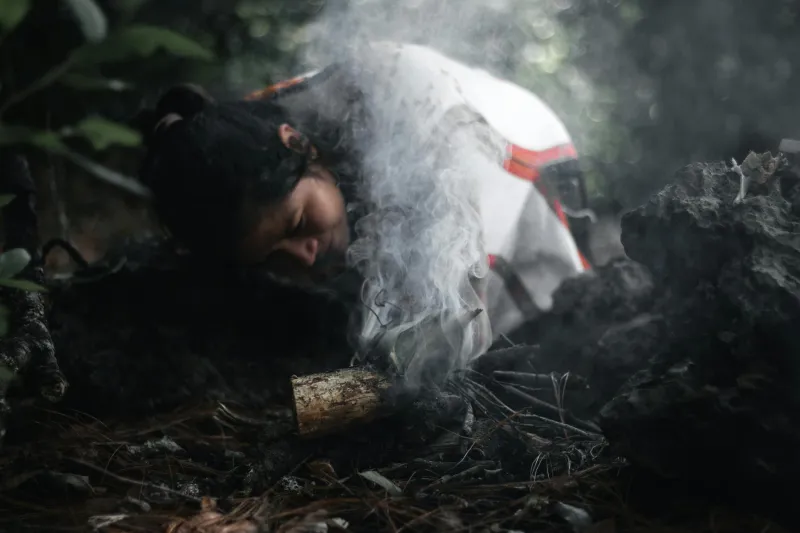
But the real genius wasn't in what they slept on — it was in how they heated their sleeping spaces. The Chumash developed a fire placement system that accidentally created perfect sleep temperature regulation.
Instead of building fires inside sleeping areas (like many other tribes), they positioned fires in carefully calculated spots outside their shelters. The warm air would circulate through the structure and exit through strategically placed openings, creating what sleep scientists now recognize as optimal thermal conditions for deep sleep.
"They essentially invented radiant heating 1,000 years before we did," notes Dr. Eus van Someren, who studies sleep and temperature regulation at the Netherlands Institute for Neuroscience. "The temperature gradient they created — warm at the feet, slightly cooler at the head — is exactly what we now know triggers the deepest sleep phases."
The fires would burn down to coals by the time people went to sleep, providing gentle, consistent warmth without the temperature spikes that disrupt sleep cycles. Modern smart thermostats are trying to recreate this same pattern of gradual cooling throughout the night.
The Tidal Clock That Regulated Their Circadian Rhythms
Perhaps the most sophisticated aspect of Chumash sleep engineering was something you couldn't see: their timing system. Living along the coast, they synchronized their sleep schedules not just with the sun, but with the tides.
This wasn't superstition — it was advanced chronobiology. The Chumash understood that their coastal environment created unique light and sound patterns that changed with tidal cycles. They timed their sleep to align with what researchers now call "optimal circadian windows."
"The tides created natural white noise during certain phases and complete silence during others," explains Dr. Russell Foster, a circadian rhythm researcher at Oxford. "The Chumash learned to use these acoustic patterns to enhance different stages of sleep."
They'd go to sleep during the quiet low tide periods, allowing for easy sleep onset. The gentle sound of incoming tides would coincide with their REM sleep phases, providing just enough auditory stimulation to enhance dream activity without causing awakening. The cycle repeated perfectly every 12 hours.
What Modern Sleep Labs Are Finally Understanding
Sleep researchers at UCSF recently built a "Chumash-inspired" sleep lab to test these principles with modern volunteers. The results were striking:
Sleep onset: 40% faster than on traditional mattresses Deep sleep duration: 25% longer phases of restorative sleep Morning alertness: Subjects reported feeling more refreshed despite sleeping the same number of hours Temperature regulation: Perfect thermal comfort without any mechanical systems
The study participants, accustomed to climate-controlled bedrooms and expensive mattresses, consistently reported that the "primitive" setup provided better sleep quality than their home environments.
The Lessons Your Bedroom Is Missing
You don't need to sleep on the ground to benefit from Chumash sleep wisdom, but you can apply their engineering principles to modern life:
Layer your sleep surface: Instead of one thick mattress, consider a firmer base with softer toppers that you can adjust seasonally.
Engineer your temperature: Use your heating system like the Chumash used fires — warm the space before sleep, then let it gradually cool throughout the night.
Align with natural cycles: If you live near water, notice how environmental sounds change throughout the night and work with them rather than blocking them out completely.
Consider your ground: The Chumash chose their sleeping spots carefully. Even in a modern bedroom, the location matters — avoid spots directly above heating vents or near electromagnetic sources.
The Sleep Industry's Missing Piece
The modern mattress industry focuses almost exclusively on the surface you sleep on, ignoring the environmental factors that the Chumash understood were equally important. We've created bedrooms that are climate-controlled, sound-isolated bubbles that disconnect us from the natural rhythms our bodies evolved to follow.
"We've optimized for comfort but not for sleep quality," observes Dr. Walker. "The Chumash optimized for both, using principles that we're only now rediscovering through expensive technology."
The irony is striking: a culture with no written language or metal tools created sleep environments that outperform our most advanced sleep technology. They did it by paying attention to what worked, generation after generation, until they'd perfected a system that modern science is still trying to understand.
The Ancient Future of Sleep
As we face an epidemic of sleep disorders in the developed world, perhaps it's time to look backward for solutions. The Chumash people spent a thousand years perfecting the art of restorative sleep using nothing but natural materials and careful observation.
Their discoveries — about ground support, thermal regulation, and circadian timing — aren't primitive relics. They're sophisticated solutions to biological problems that haven't changed since humans first needed to sleep safely through the night.
The next time you toss and turn on your expensive mattress in your climate-controlled bedroom, remember the coastal people who slept soundly on carefully prepared ground, warmed by perfectly positioned fires, timed to the rhythm of the tides.
They understood something we're still learning: the best sleep technology isn't always the newest technology. Sometimes it's the wisdom that's been tested by time itself.